 | 2016 Why Do Parents Want to Know their Child’s Carrier Status? A Qualitative Study [Supported]Author(s):
When a child is identified with a genetic condition, |

 | 2016 The Ethics of Deprescribing in Older Adults [Supported]Author(s): Emily Reeve Deprescribing is the term used to describe the process of withdrawal of an inappropriate medication supervised by a clinician. This article presents a discussion of how the Four Principles of biomedical ethics (beneficence, non-maleficence, autonomy, and justice) that may guide medical practitioners’ prescribing practices apply to deprescribing medications in older adults. The view of deprescribing as an act creates stronger moral duties than if viewed as an omission. This may explain the fear of negative outcomes which has been reported by prescribers as a barrier to deprescribing. Respecting the autonomy of older adults is complex as they may not wish to be active in the decision-making process; they may also have reduced cognitive function and family members may therefore have to step in as surrogate decision-makers. Informed consent is intended as a process of information giving and reflection, where consent can be withdrawn at any time. However, people are rarely updated on the altered risks and benefits of their long-term medications as they age. Cessation of inappropriate medication use has a large financial benefit to the individual and the community. However, the principle of justice also dictates equal rights to treatment regardless of age. |
 | 2016 [Supported] Author(s): Peter Zweifel Insurance Economics brings together the economic analysis of decision making under risk, risk management and demand for insurance by individuals and corporations, objectives pursued and management tools used by insurance companies, the regulation of insurance, and the division of labor between private and social insurance. Appropriete both for advanced undergraduate and graduate students of economics, management, and finance, this text provides the background required to understand current research. Predictions derived from theoretical argument are not only stated but confronted with empirical evidence. Throughout the book, conclusions summarize results, helping readers to check their knowledge and understanding. Issues discussed include paradoxa in decision making under risk, selection of favorable risks by insurers, the possibility of a "death spiral" in insurance markets, and future challenges such as re-regulation in the wake of the 2007-09 financial crisis and the increasing availability of generic information. |
 | 2016 Population Perspectives and World Health Organization Recommendations for CYD-TDV Dengue Vaccine [Supported]Author(s): Annelies Wilder-Smith In late 2015, after decades of research, the world's first dengue vaccine was licensed. Data generated by a comprehensive and very large phase 3 clinical trial program for the CYD-TDV vaccine (Dengvaxia), developed by Sanofi Pasteur [1], in 10 dengue-endemic countries in Asia and Latin America [2, 3] revealed complex findings for the vaccine's performance, which were unpredicted and unprecedented. Nevertheless, and apart from significant imperfections of the vaccine, it qualifies as an additional tool in the scarce armamentarium for dengue control. In light of the rising incidence of a disease currently estimated to clinically affect about 100 million individuals annually [4], this is a major step forward. |

 | 2016 [Supported] Author(s): Heather Zierhut,Dianne M. Bartels,Margaret L. MacMillan,John E. Wagner Preimplantation genetic diagnosis (PGD) to create a healthy donor for a sibling's hematopoetic stem cell transplantation for a child with Fanconi Anemia (FA) was first reported in 2001. Yet we know little about the experiences of parents who have encountered decision making surrounding PGD and human leukocyte antigen (HLA)-typing. The first aim of this study was to understand parents' awareness, perceptions and beliefs about reproductive decision-making including emotional, cognitive, moral dimensions as well as regret surrounding the use of this technology. The second aim was to describe the experiences and rationale of parents of children with a single gene disorder regarding the factors that influenced their decision making surrounding the use of natural pregnancy and/or PGD and HLA-typing. Parents from two national FA support networks in the US and Canada responded to an emailed survey about reproductive decision making and outcomes surrounding natural pregnancy and PGD and HLA-typing. Descriptive statistics and Pearson's Chi-Square tests were used to describe and compare data. Our results indicate that the most important factors in the PGD decision making process were the health of the child and cognitive appraisals followed by emotional responses and then moral judgments. A significant difference was noted in parents considering natural pregnancy before and after 2001 (p = 0.01). Unexpected findings were that less than 35 % of parents were offered PGD by any health care professional and only 70 % were aware PGD with HLA-typing was a reproductive option. Our research suggests that the option of PGD and HLA-typing may influence parents' reproductive decision making choices. |
 | 2016 [Supported] Author(s): Christine Hauskeller,Lorenzo Beltrame By theme: Biobanks, Stem cells / Cloning Umbilical cord blood (UCB) is an important source for stem cells used in clinical treatments. For this purpose, UCB has to be collected at birth and stored in biobanks. The discourse about UCB biobanking practices commonly holds that it occurs in two opposite economies, the public sector and a competing private one. They correspond with moral economies of gift-giving in a redistributive economy versus private ownership of cord blood in a market economy. Our analysis of UCB banking in Europe shows that this opposition narrative is both empirically and analytically unsatisfactory. Using the analytic concepts of entanglement (Callon) and biomedical platforms (Keating and Cambrosio), we demonstrate how the network of actors, objects, interests and practices in biobanking creates different kinds of value and shared issues across public and private services. Our case study illustrates how the interrelation between technical, ethical, economic and logistical considerations plays out and generates a field of practices where redistributive and market economies coexist, are co-dependent and hybridize each other. The narrative of opposition therefore can inform STS studies regarding the normative values written into the public facing side of biobanking, but bioeconomic analyses benefit from building on concepts that enable the examination of the complex interrelations between the wider network of heterogeneous elements on which UCB banking relies. |
| 2016 [Supported] Author(s): Michelle Bayefsky |
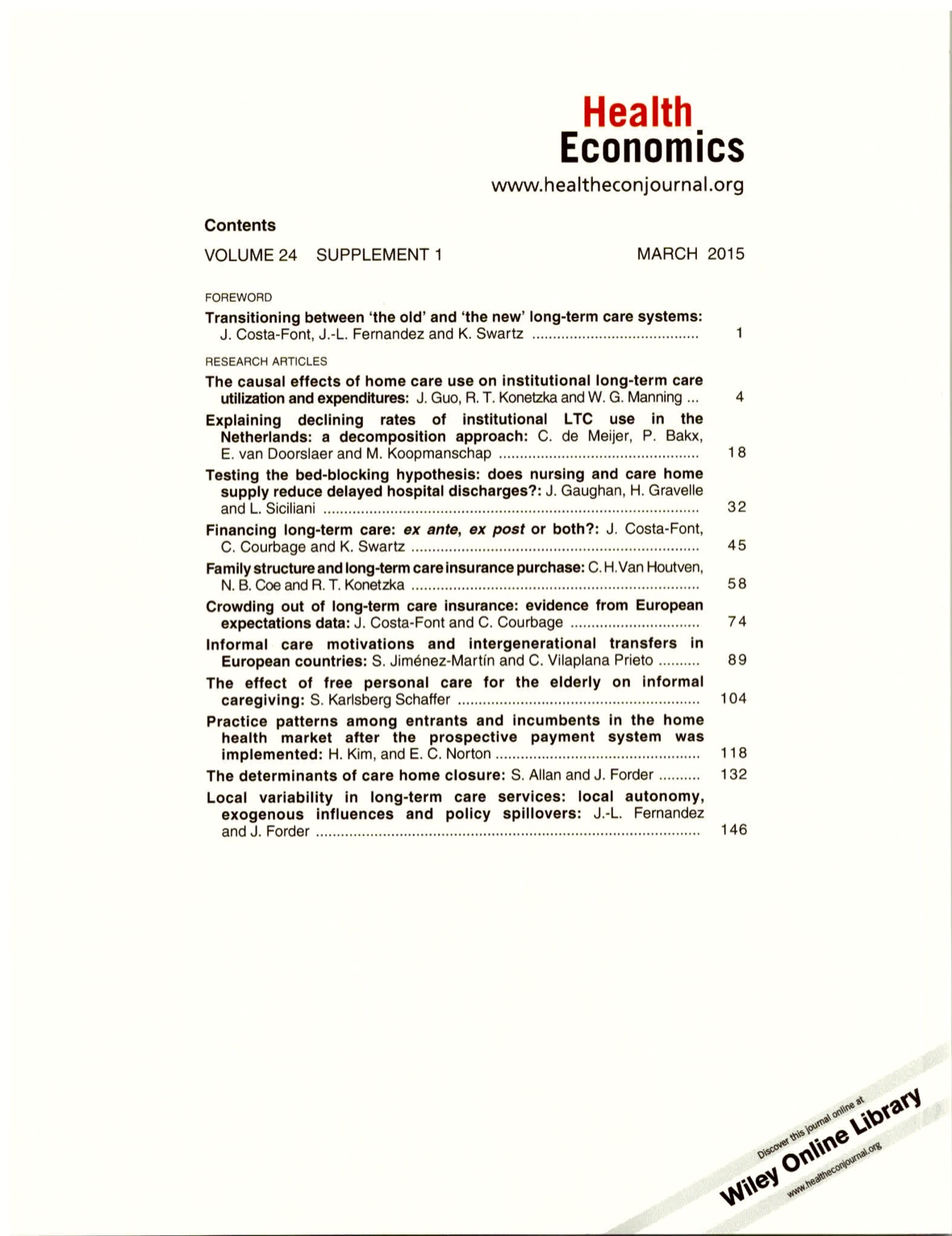
 | 2015 [Supported] Author(s): Joan Costa-Font,Jose-Luis Fernandes,Katherine Swartz By theme: Other Health Economics : Volume 24 / Supplement 1 / March 2015 |
 | 2015 What Happens & What Matters : A study on Palliative and Terminal Care in the Hospital [Supported]Author(s): Erica Witkamp By theme: End of life |
 | 2015 [Supported] Author(s): Susanne Uusitalo What happens when an addicted individual acts in accordance with his addiction? The study provides an answer and makes this kind of action and agency understandable. By showing that three common views on addiction fall short of capturing the phenomenon, Uusitalo will provide characteristics that jointly suffice for something to be labelled addiction, but which are not, however, individually necessary (or sufficient) for addiction. The characteristics - Strong desire, myopia, biased descision-making, and weakness of will - should be understood in the framework of diachronic, active agency. |
 | 2015 [Supported] Author(s): Diego Silva,Maxwell Smith The unprecedented outbreak of Ebola virus disease (EVD) in West Africa has raised several novel ethical issues for global outbreak preparedness. It has also illustrated that familiar ethical issues in infectious disease management endure despite considerable efforts to understand and mitigate such issues in the wake of past outbreaks. To improve future global outbreak preparedness and response, we must examine these shortcomings and reflect upon the current state of ethical preparedness. To this end, we focus our efforts in this article on the examination of one substantial area: ethical guidance in pandemic plans. We argue that, due in part to their focus on considerations arising specifically in relation to pandemics of influenza origin, pandemic plans and their existing ethical guidance are ill-equipped to anticipate and facilitate the navigation of unique ethical chal- lenges that may arise in other infectious disease pandemics. We proceed by out- lining three reasons why this is so, and situate our analysis in the context of the EVD outbreak and the threat posed by drug-resistant tuberculosis: (1) different infectious diseases have distinct characteristics that challenge anticipated or existing modes of pandemic prevention, preparedness, response, and recovery (2) clear, transparent, context-specific ethical reasoning and justification within current influenza pan- demic plans are lacking (3) current plans neglect the context of how other significant pandemics may manifest. We conclude the article with several options for reflecting upon and ultimately addressing ethical issues that may emerge with different infectious disease pandemics. |
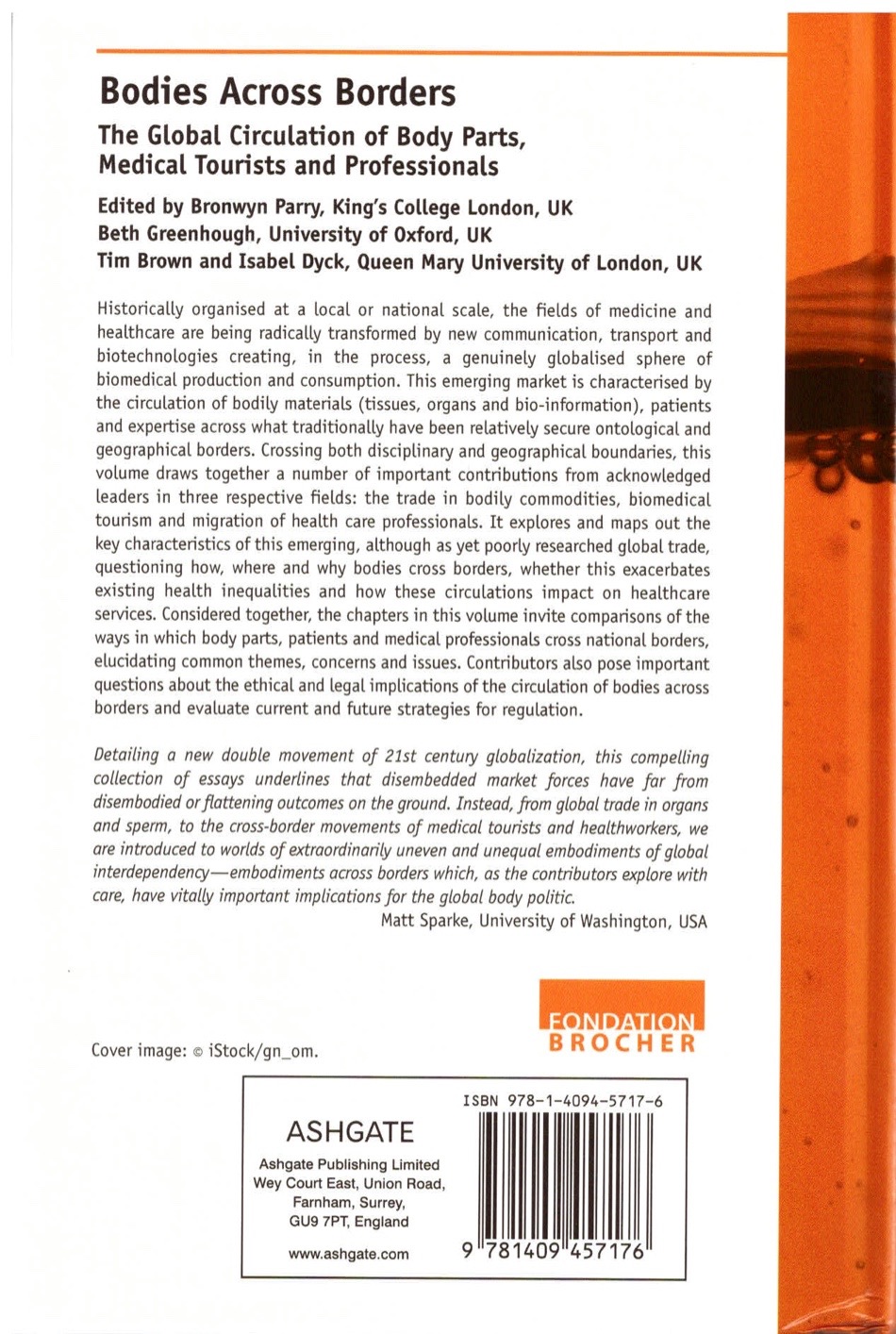
 | 2015 [Supported] Author(s): Bronwyn Parry,Beth Greenhough,Tim Brown,Isabel Dyck Historically organised at a local or national scale, the fields of medicine and healthcare are being radically transformed by new communication, transport and biotechnologies creating, in the process, a genuinely globalised sphere of biomedical production and consumption. This emerging market is characterised by the circulation of bodily materials (tissues, organs and bio-information), patients and expertise across what traditionally have been relatively secure ontological and geographical borders. Crossing both disciplinary and geographical boundaries, this volume draws together a number of important contributions from acknowledged leaders in three respective fields: the trade in bodily commodities, biomedical tourism and migration of health care professionals. It explores and maps out the key characteristics of this emerging, although as yet poorly researched global trade, questioning how, where and why bodies cross borders, whether this exacerbates existing health inequalities and how these circulations impact on healthcare services. Considered together, the chapters in this volume invite comparisons of the ways in which body parts, patients and medical professionals cross national borders, elucidating common themes, concerns and issues. Contributors also pose important questions about the ethical and legal implications of the circulation of bodies across borders and evaluate current and future strategies for regulation. |
 | 2015 Why is Pain Still Under-Treated in the Emergency Department? Two New Hypotheses [Supported]Author(s): Drew Carter,Paul Sendziuk,Jaklin A. Eliott,Annette Braunack-Mayer Across the world, pain is under-treated in emergency departments (EDs). We canvass the literature testifying to this problem, the reasons why this problem is so important, and then some of the main hypotheses that have been advanced in explanation of the problem. We then argue for the plausibility of two new hypotheses: pain's under-treatment in the ED is due partly to (1) an epistemic preference for signs over symptoms on the part of some practitioners, and (2) some ED practices that themselves worsen pain by increasing patients' anxiety and fear. Our argument includes the following logic. Some ED practitioners depart from formal guidance in basing their acute pain assessments on observable features rather than on patient reports of pain. This is potentially due to an epistemic preference for signs over symptoms which aims to circumvent intentional and/or unintentional misrepresentation on the part of patients. However, conducting pain assessments in line with this epistemic preference contributes to the under-treatment of pain in at least three respects, which we detail. Moreover, it may do little to help the practitioner circumvent any intentional misrepresentation on the part of the patient, as we explain. Second, we examine at least four ED practices that may be contributing to the under-treatment of pain by increasing patient anxiety and fear, which can worsen pain. These practices include failing to provide orienting information and partially objectifying patients so as to problem-solve along lines pre-established by modern medical science. We conclude by touching on some potential solutions for ED practice. |
 | 2015 Luck Eegalitarianism, Social Determinants and Public Health Initiatives [Supported]Author(s): Andreas Albertsen By theme: Global health People’s health is hugely affected by where they live, their occupational status and their socio-economic position. It has been widely argued that the presence of such social determinants in health provides good reasons to reject luck egalitarianism as a theory of distributive justice in health. The literature provides different reasons why this responsibility-sensitive theory of distributive justice should not be applied to health. The critiques submit that (i) the social circumstances undermine or remove people’s responsibility for their health; (ii) responsibility sensitive health policies would adversely affect those who are worst off and; (iii) the luck egalitarian approach to health distracts from the important task of rectifying socio-economic influences on people's health and provides individualistic solutions to collective problems. But for each of these variants of the critique luck egalitarianism provides suitable answers. The literature on social determinants is no detriment to the project of applying luck egalitarianism to health. |
| 2015 Assessing an Adolescent’s Capacity for Autonomous Decision-Making in Clinical Care [Supported]Author(s): Pierre-André Michaud,Robert Wm Blum,Lazare Benaroyo,Jean Zermatten,Valentina Baltag The purpose of this article is to provide policy guidance on how to assess the capacity of minor adolescents for autonomous decision-making without a third party authorization, in the field of clinical care. In June 2014, a two-day meeting gathered 20 professionals from all continents, working in the field of adolescent medicine, neurosciences, developmental and clinical psychology, sociology, ethics, and law. Formal pre- sentations and discussions were based on a literature search and the participants’ experience. The assess- ment of adolescent decision-making capacity includes the following: (1) a review of the legal context consistent with the principles of the Convention on the Rights of the Child; (2) an empathetic relationship between the adolescent and the health care professional/team; (3) the respect of the adolescent’s devel- opmental stage and capacities; (4) the inclusion, if relevant, of relatives, peers, teachers, or social and mental health providers with the adolescent’s consent; (5) the control of coercion and other social forces that in- fluence decision-making; and (6) a deliberative stepwise appraisal of the adolescent’s decision-making process. This stepwise approach, already used among adults with psychiatric disorders, includes under- standing the different facets of the given situation, reasoning on the involved issues, appreciating the outcomes linked with the decision(s), and expressing a choice. Contextual and psychosocial factors play pivotal roles in the assessment of adolescents’ decision-making capacity. The evaluation must be guided by a well-established procedure, and health professionals should be trained accordingly. These proposals are the first to have been developed by a multicultural, multidisciplinary expert panel. |
 | 2015 [Supported] Author(s): Maxwell Smith,Diego Silva Public health is intimately related to social justice, which is why practice and research in the field seek to improve the social determinants of health. Despite the best intentions of those working in public health, however, some policies and practices inadvertently further disadvantage pre-existing marginalized populations. In this paper, we provide a diagnosis of possible reasons why this phenomenon might occur. We posit that the challenges associated with further marginalizing certain populations stem from a) not acknowledging the normative aspects of apparently objective data, b) a misunderstanding and an uncritical alignment of public health goals with the ethics theory of utilitarianism, and c) assuming that those working in public health might be able to fully understand the experiences of marginalized populations. It is our view that the trend of public consultation with marginalized persons, the explicit teaching of ethics and philosophy of science in graduate departments of public health, and the increased use of health equity impact assessments might help protect against public health policies and practices that disadvantage marginalized populations. |
 | 2015 Health Equity in Public Health: Clarifying our Commitment [Supported]Author(s): Maxwell Smith,Diego Silva Health equity is increasingly identified as a principal goal to be achieved through public health policies and activities. However, what is to be measured in the assessment of health equity and how inequities in health ought to be redressed are among the pressing questions that must be answered if health equity is to serve as a meaningful and consistent ethical guide for measurement and intervention in public health. In this article I argue that the concept of health equity, in the form it is predominantly found in public health, suffers from normative indeterminacy and is therefore unlikely to provide actionable normative guidance to public health policy- makers, practitioners and researchers. I argue that the concept of health equity, as it is commonly defined in public health, ultimately rests upon assumptions of a more fundamental, yet tacit, conception of justice to do its normative work. In this vein, I expand upon a critique of Margaret Whitehead’s (1992) oft-cited definition of health equity made by James Wilson (2011) to raise additional reasons not explored by Wilson, or others, as to why Whitehead’s definition remains inadequate in providing normative guidance to policy-makers, practitioners and researchers in public health. |
 | 2015 Ethical Dilemmas for Critically Ill Babies [Supported]Author(s): Verhagen Eduard,Janvier Annie
Most neonates who now survive intensive care would have died 50 years ago, and “nature” would have decided the outcomes, making ethical discussions about initiating or withholding resuscitation irrelevant. Medical developments in neonatology have changed the way we respond to diseases of neonates, to their illness, and to their parents. Not only as physicians, but also as a society. |
| 2015 Will a Nobel Prize Change China’s Perspective on Innovation? [Supported]Author(s): Yeyang Su,Samantha Vanderslott On the evening of October 5th, 2015, Tu Youyou, aged 85, received a phone call at her home in Beijing from Adam Smith, congratulating her on sharing half of this year’s Nobel Prize in Physiology or Medicine, for ‘her discoveries concerning a novel therapy against Malaria’. It was four years after Tu received the Lasker Prize the most prestigious in medicine, and about forty years after she and her team discovered the method to isolate Artemisinin from the herb Artemisia annua (qinghao, 青蒿) This herb had been used by Chinese herbalists for thousands of years to treat many illnesses, including Malaria.... |
| 2015 [Supported] Author(s): HIV-affected women and couples often desire children and many accept HIV risk in order to attempt pregnancy and satisfy goals for a family. Risk reduction strategies to mitigate sexual and perinatal HIV transmission include biomedical and behavioural approaches. Current efforts to integrate HIV and reproductive health services offer prime opportunities to incorporate strategies for HIV risk reduction during pregnancy attempts. Key client and provider values about services to optimize pregnancy in the context of HIV risk provide insights for the design and implementation of large-scale ‘‘safer conception’’ programmes. Discussion: Through our collective experience and discussions at a multi-disciplinary international World Health Organization |