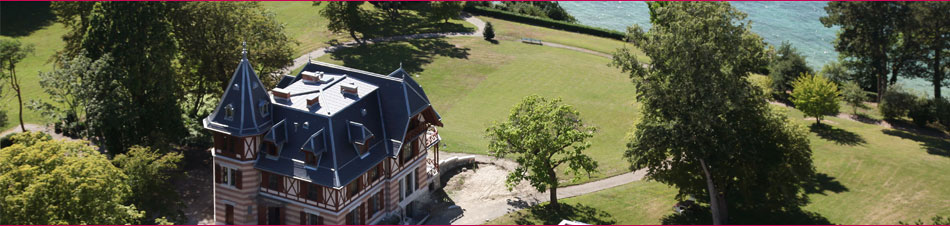
L’utilité de ce genre d’institutions est incontestable. Car le monde moderne est sans cesse confronté à des innovations, médicales ou autres, qui s’appliquent à l’homme ou à son environnement proche. Ce lieu est donc nécessaire pour préparer la matière intellectuelle qui sera ensuite transférée aux citoyens afin que ceux- ci puissent se prononcer quant à la légitimité de ces innovations.

 

Professeur Axel Kahn, le célèbre généticien français, lors de l’inauguration de la Fondation Brocher en 2007

Dons

La Fondation Brocher est une fondation de droit privé suisse à but non lucratif et reconnue d'intérêt public. Vos dons sont à ce titre déductibles fiscalement, selon les normes légales en vigueur.

Retour


14 - 16 novembre 2012
Brocher workshop

We are family? Perceptions of relatedness in assisted conception

Lieu:

Centre Brocher

Introduction:

This workshop addresses the nature and meaning of relationships and identity in assisted conception, problematizing assumptions about ‘genetic’ and ‘social’ relatedness that lie at the heart of contemporary ethical debates in this field.

Assisted conception both challenges and reinforces traditional perceptions of family relatedness bound by psychological, social, biological, moral and legal ties.

Assisted conception procedures may involve the use of known or unknown sperm, egg or embryo donors as well as surrogates who carry pregnancies for others, to build families parented by heterosexual or same-sex couples, single people or more complex shared parenting arrangements. Such collaborative reproduction raises questions about relatedness for parents, children and other people who may be involved in the conception, gestation and care of a child, as well as their family members. In turn, the meanings that people attach to relatedness are shaped by their personal and social circumstances as well as the wider cultural, legal and policy landscape in which collaborative reproduction occurs.

A series of multidisciplinary presentations will explore these questions of relatedness, bringing together empirical insights from psychological, social, anthropological and clinical research and ethical and legal analyses from leading international scholars in the field. Particular attention will be paid to how social expectations of having ‘a child of one’s own’ and knowing about one’s ‘genetic origins’ may inform people’s perceptions and choices regarding assisted conception, and the role that gender, sexuality and ethnicity may play. Contributions will introduce the most up-to-date, cutting edge empirical research on assisted conception, including, for example, the experiences of solo mothers and gay fathers, parents in UK South Asian communities, grandparents of donor-conceived children and donor offspring who seek contact with their donor and donor siblings, as well as addressing legal, policy and commercial aspects of assisted conception with case-studies from around the world.  These empirical insights will be combined with ethical analyses of the nature of genetic and family relationships and the many dilemmas raised at each stage of collaborative reproduction, from debates about a child’s right to knowledge of their origins to decisions made by parents about the disposition of their supernumerary cryopreserved embryos.

The presentations will be published as an edited volume by Cambridge University Press, edited by Tabitha Freeman, Fatemeh Ebtehaj, Susanna Graham and Martin Richards. This workshop is part of a broader 5-year project entitled “Redefining Families: Bioethics, Assisted Reproduction and Emerging Family Forms”,  for which the Centre for Family Research, University of Cambridge, currently holds a Wellcome Trust Enhancement Award in Biomedical Ethics.


Organisé avec:

Statham Helen  Senior Research Associate Centre for Family Research University of Cambridge
Freeman Tabitha Research Associate  Centre for Family Research University of Cambridge
Golombok Susan Professor of Family Research and Director of the Centre for Family Research  Centre for Family Research University of Cambridge